How fast is the universe expanding? 2026 standard siren results
2026 observational study · V2 release of preprint · Tensions not yet resolved
File: 3 October 2026 · First post May 26, 2026; August 4, 2026 updated v2
Why do we measure expansion rate?
The expansion of the universe is a question of how distances change over time on a large scale. The Hubble constant H₀, which summarizes the current expansion rate, is one of the fundamental quantities of cosmology. The “constant” in its name does not mean that the rate of expansion has remained the same throughout all cosmic history; H₀ represents the present value. The unit of measurement is km/s/Mpc: it gives the scale of the relationship between speed and distance. It would be misleading to think of this as the speed of a single edge, such as "the universe is growing this many kilometers per second." A general expansion model and the motion of a particular galaxy itself must also be distinguished.
What is the Hubble voltage?
NASA's explanation addresses the discrepancy between the results obtained from distance measurements in the near universe and the results obtained from the interpretation of early universe data within a cosmological model. In the near universe, instruments such as Cepheid variable stars and supernovae are used in the distance measurement chain. The early universe approach is based on different observations and model assumptions. The expression “two telescopes found different numbers” oversimplifies the problem. The discussion is between methods, uncertainties, and models. The existence of this tension may suggest new physics, but it alone does not determine which new theory is correct. NASA: Hubble constant and stress
A different measurement channel than light
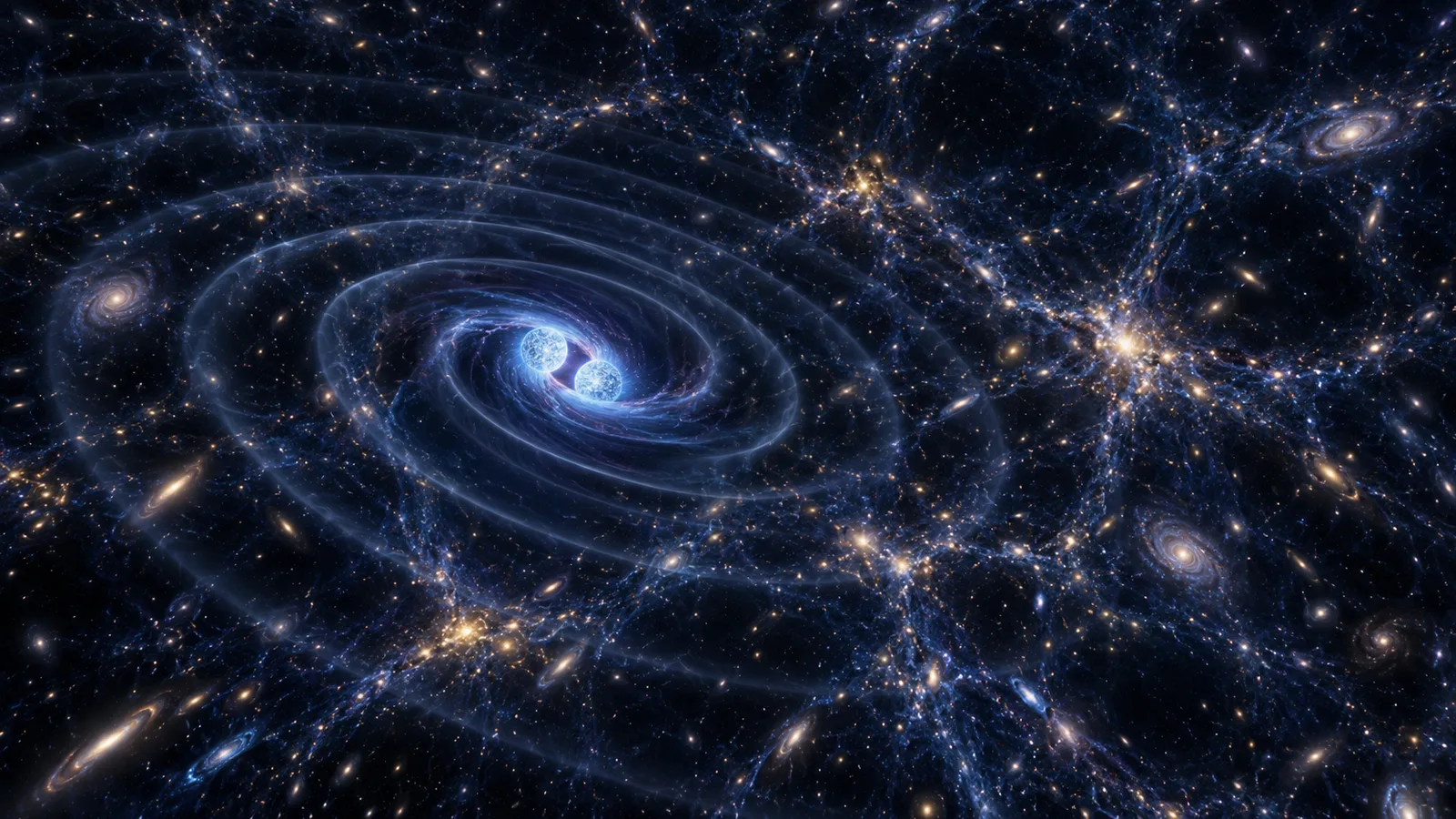
The measurement with gravitational waves uses another physical messenger. The wave signal of the combined compact objects helps infer the weld distance with the appropriate model; this approach is called the standard siren. The official summary of LIGO-Virgo-KAGRA describes the combination of distance information with redshift information. When an electromagnetic companion can be found, the host galaxy can be determined more directly. In most cases, statistics on candidate galaxies or the resource community come into play. Therefore, the word “siren” does not mean a sound heard in space; it is the name of the cosmic measurement method. LVK: description of the standard siren method
Updated result of the 2026 survey
GWTC-5.0 kozmoloji çalışmasının 4 August 2026 tarihli v2 ön baskısı, 236 gravity dalgası kaynağını kullanıyor. Birleşik sonuç H₀ = 71,7; alt belirsizlik 7,5 ve üst belirsizlik 9,4 km/s/Mpc olarak veriliyor. Bu, yüzde 68 simetrik Bayesçi güvenilirlik aralığıyla ifade edilmiş medyandır; kabaca 64,2–81,1 km/s/Mpc aralığına karşılık gelir. Makale, önceki GWTC-4.0 ölçümüne göre belirsizlikte yüzde 22,0 azalma bildiriyor. Sonucun tek başına Hubble gerilimini çözdüğünü söylemiyoruz. Kaynak bilgisi doğrulanmış olsa da arXiv kaydı tek başına hakemli yayıma eşit değildir. Updated preprint, v2
Why is there a different number in the short summary?
71.0 in the official science summary; It says 25.7 percent sensitivity improvement with a lower uncertainty of 7.1 and an upper uncertainty of 9.0. The summary of the updated v2 preprint gives the different values from the previous section. In order not to confuse the numbers in this file, we use the v2 record as the basis by clearly stating the version. We do not infer a new physical tension from the difference between the two texts; The source versions are not the same. Checking the date and version of a news story is not just an academic detail, it is a necessary step for the reader to find the same result again.
Bright, dark and spectral sirens
The LVK summary describes three information paths: the bright siren, which is contacted with the electromagnetic companion; catalog approach that statistically uses possible host galaxies; Spectral sounder that exploits features in the mass distribution of sources. The “darkness” here is not specific evidence that dark matter is present in the source; It is the name for the method in which the host galaxy cannot be determined singularly. Using different methods together can be useful, but it is necessary to take into account the assumptions and selection effects of all of them. The combined result does not mean a direct reading of the raw data without using any models.
What does an uncertainty interval say?
Our editorial reading note: a single central number is not the entire study. The width of the range indicates what values the data can distinguish. In Bayesian evaluation, the range is defined in the data and selected model conditions; It does not mean that all model errors are absolutely eliminated. Even if the center values of two different methods are different, large ranges can overlap. Therefore, it is not correct to use a sentence such as "71 found, the discussion is over". To compare results, one must examine how uncertainties are defined, which data version is used, and whether common systematic effects are found.
Redshift isn't just color
Redshift refers to the wavelength shifting to longer values. In astronomy, spectral lines are used to quantify this shift; It is not enough to look at the color of the galaxy, which appears red in a single photograph. The colors in the photo are also related to filters, processing and the object's own radiation. The cosmological interpretation evaluates the relationship between measured shift and distance in a model. The local motion of a galaxy may also be important, especially in the nearby universe. Therefore, treating distance and redshift as two separate pieces of information makes it easier to understand the measurement of cosmic expansion.
What does this research give us?
A new measurement channel provides the opportunity to compare existing methods with different physical assumptions and sources of error. The updated summary of the research also reports that parameterized tests of gravitational wave propagation found no departure from general relativity. However, the statement “no separation observed” does not mean that all possible alternatives have been excluded. The models examined and measurement accuracy are important. As a reader, you may ask: what makes the most difference: more events, more accurate galaxy catalogs, or reducing model uncertainties? Share your reason below; The goal is not to make a definitive prediction, but to consider the next step of the research.
Kaynaklar
LVK—GWTC-5.0 cosmology preprint, v2 (August 4, 2026)
LIGO–Virgo–KAGRA — official science summary; The version difference is explained in the article