Established science · From atomic clocks to gravitational waves tested with high precision
Why doesn't time flow the same for everyone?
Relativity suggests that space and time are not a fixed scene; It says that the measurements are related to the motion of the observer and the gravitational field in which it is located. The theory does not say "everything is relative": it includes immutable constructs such as the speed of light, space-time interval, and the form of the laws of physics.
Basic framework
In special relativity, simultaneity depends on the observer. As speed increases, moving clocks measure less time, lengths in the direction of motion become shorter, and the energy-momentum relationship goes beyond classical mechanics. These effects are measured in particle accelerators and when muons formed in the upper atmosphere reach the earth.
crux of the debate
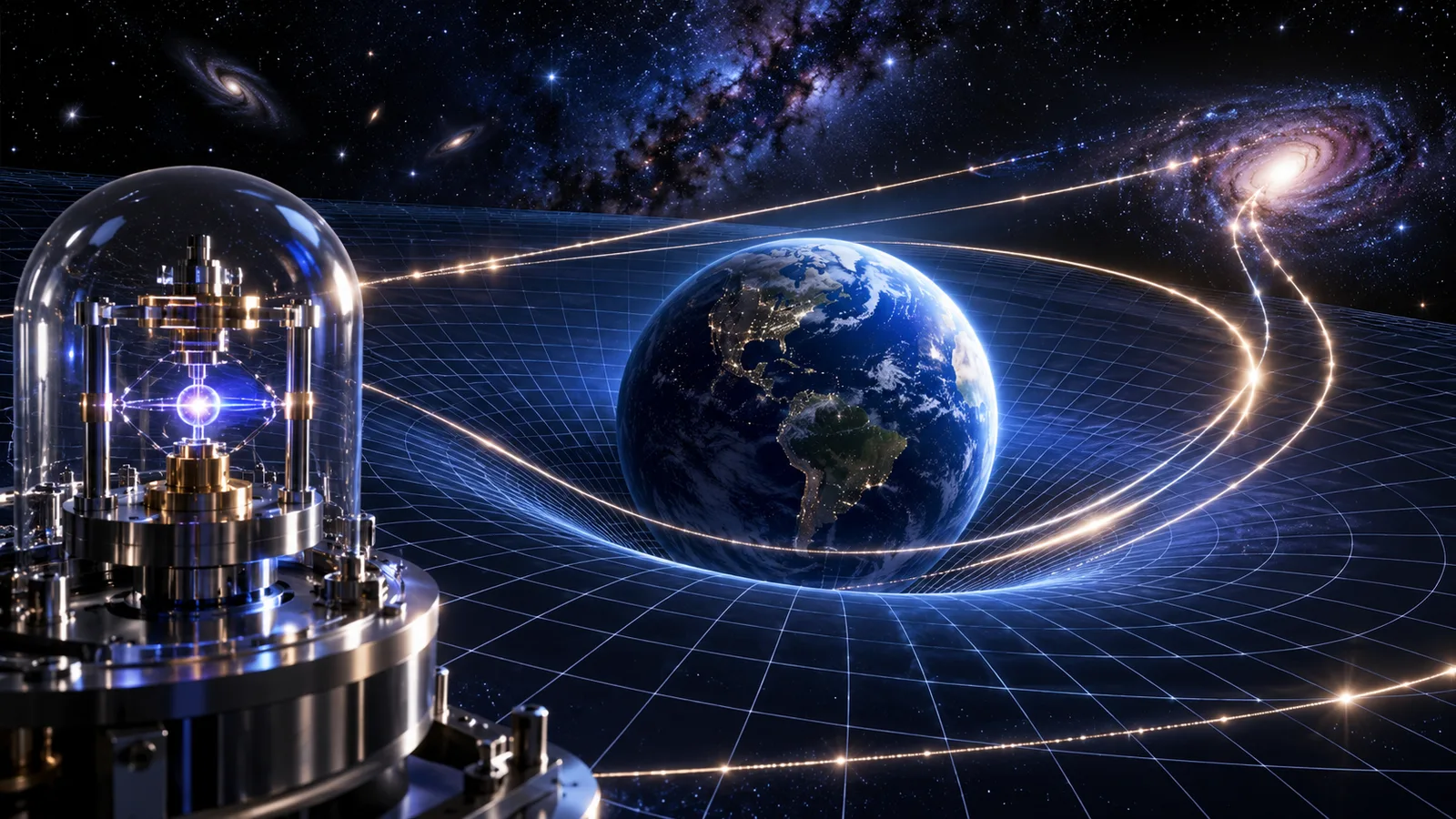
General relativity explains free fall as natural motion in curved space-time. Mass and energy determine geometry; Geometry also tells matter how to move. Gravitational redshift, bending of light, Mercury orbit, and energy loss of binary systems are tests of the same framework.
Today's knowledge frontier
GPS satellite clocks need corrections for both special relativity due to motion and general relativity due to the weaker gravitational field. Gravitational waves measured directly in 2015 turned black hole mergers into a new observation channel. Quantum gravity and singularities are the clear limits of the theory.
Why are space and time unified?
Special relativity shows that measurements of length and duration may vary between observers moving at different speeds; However, it shows that the speed of light remains the same. Therefore, space and time are not independent scenes, but four-dimensional space-time in which events take place together. Even simultaneity may depend on the movement of the observer.
Gravity is more than a force
In general relativity, what keeps planets in orbit is not thought of as an invisible string pulling them from afar. Matter and energy change the geometry of space-time; Objects follow the most natural paths possible within this curved geometry. The deflection of starlight near the Sun, details of Mercury's orbit, atomic clocks, and gravitational waves are tests of this framework.
open problems
General relativity is extraordinarily successful at large scales, quantum mechanics at subatomic scales; However, in cases such as the interior of black holes and the earliest moments of the universe, it is necessary to use the two theories together. The search for quantum gravity is the main reason for the emergence of different programs such as loop quantum gravity and string theory.
How is it tested?
Atomic clocks measure different times depending on altitude and speed differences. The GPS system requires both special and general relativity corrections. The bending of light around large masses and the gravitational waves measured by observatories like LIGO are experimental traces of space-time geometry.
Where is the border?
General relativity points to its limit at singularities; We do not have an experimental theory of gravity that is fully integrated with quantum mechanics. Wormholes may be possible solutions to equations, but there are no observations showing that they are stable and traversable.
Featured reviews
Albert Einstein — explained gravity as space-time geometry.
Kip Thorne — developed the physics of black holes, gravitational waves, and wormholes.
Source: Einstein Online