How does space-time bend light? Gravitational lenses and Euclid
Observational phenomenon · We distinguish between the candidate lens and the validated system
File: 3 October 2026 · 19 March 2025 catalog announcement and 21 April 2026 Space Warps call
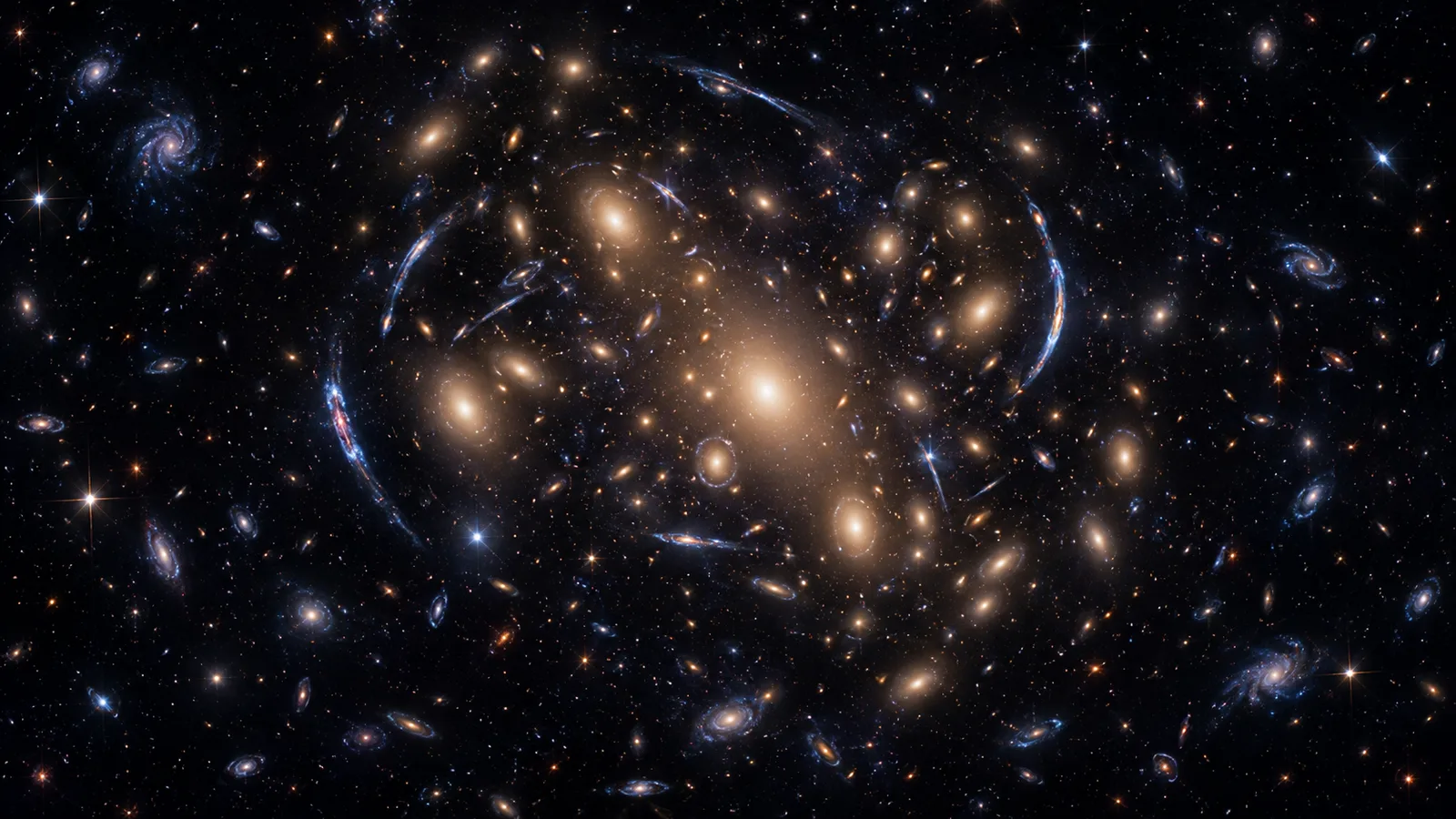
Why does a galaxy appear arc-shaped?
When light from a background galaxy passes near a large mass distribution in the foreground, its image can be distorted. In general relativity, this relates to the path of light through curved spacetime. The observation may reveal springs, rings, or multiple images of the same background source. The conclusion that “the galaxy is really in the form of a ring” is therefore not always true; the shape seen is the joint product of the source and the lens geometry. Nasa's Hubble narrative explains that natural lenses can magnify and make visible distant objects. NASA: the foundation of gravitational lenses
Einstein ring: Alignment matters
When the source, foreground lens, and observer are properly aligned, the background light can give the appearance of a ring. When alignment and mass distribution change, fragmented arcs or separate images may form instead of a full ring. That's why not every lens looks the same. The image of a ring does not indicate that there is a tangible circle in space. The directions the light comes from are different and we record them on an image plane. Here the telescope collects information from behind the natural lens. The analogy that “the universe acts like a magnifying glass” is useful, but the actual process does not rely on light passing through glass.
Strong and weak lensing
Strong lensing distortion can be noticeable in a single system. In weak lensing, small shape changes are often examined by statistical evaluation of a large number of galaxies. Seeing a single slightly elongated galaxy does not by itself tell how much lensing is applied to it; The shape of the galaxy itself is also important. Finding strong lens candidates for a study is not the same as producing a map of weak lenses over a wide area. This distinction helps understand why scanning tasks like Euclidean need both detailed images and large samples.
Are we photographing dark matter?
Dark matter does not behave like a type of matter that we directly view with visible light; it is inferred by the effects of gravity. Lensing gives information about the total mass distribution that affects the path of light. However, it is wrong to assume that the bright area in a colored image is "dark matter itself"; sometimes that area is the visualization of the map extracted from a model. Nasa's description of dark matter emphasizes evaluating gravitational effects along with visible matter. The lens map alone does not determine which particle constitutes dark matter. NASA: dark matter and circumstantial evidence
What did Euclid's 2025 catalog contain?
On 19 March 2025, the ESA announced the creation of nearly 500 galaxy-galaxy-powerful lens candidates from its first deep-field observations. The election combined the stages of AI screening, citizen scrutiny, expert assessment, and modeling. The word “candidate” is important here: entering the list does not mean that all physical details about an object are finalized. We do not present the issue as a new catalog published today; we convey the content of the announcement dated 2025. In this file, we do not use the expected catalog sizes as realized results. ESA: 2025 candidate catalogue
Research involving users in 2026
On April 21, 2026, ESA introduced the Euclid Space Warps citizen science project. Through Zooniverse, volunteers can contribute to finding powerful lens candidates in Euclid images. The purpose of this is not just to pick out beautiful shapes, but to help investigate rare systems in a large dataset. The subject classification is not a substitute for scientific validation; it is part of the research chain. If you're interested, you can read the methods and terms of participation on the official project link. The representative drawings on our site are not images of this dataset. ESA: 2026 proje duyurusu
Model behind a photo
Our editorial method note: to produce description from a lens image, the location of the source, the foreground mass distribution, and the characteristics of the observing device are considered together. Different models may produce some similar images; Therefore, one should not draw too definitive conclusions from a single impressive arc. Additional images, spectral measurements, and other observations can strengthen the comparison. At this point, there is a difference between “we saw” and “we deduced from the model”. For example, the arc is an observation property; How the total mass is distributed can be an inference calculated by modeling. A good science visual description does not hide this difference.
Limit of natural telescope
Magnification can make it easier to examine the background source; but the image is often distorted. Understanding the source requires an explanation that takes this distortion into account. Even if the signal becomes stronger, not all uncertainties disappear. This is different from everyday photographic magnification: lensing involves changing the paths of light before observation. Multiple images of the same source can appear as if there are multiple duplicate objects in the sky. Therefore, instead of interpreting distant universe images by looking only at their shape, it is more reliable to read the image description and lens information together.
A better image reading with three questions
Is this image real telescope data, a simulation, or an artist's drawing? Is the apparent arc the shape of the source galaxy itself or the effect of lensing? Is the mass described the directly visible matter or the total mass based on the model? When you ask these three questions, you do not underestimate the visual; You can read the information it carries more accurately. You can write in the response field below what you think of an Einstein ring at first glance. Then add what information would change your initial interpretation. In this way, we can evaluate the aesthetic effect of a photograph without separating its scientific explanation.
Kaynaklar
NASA — Hubble Gravitational Lenses