New test of space-time: 2026 gravitational wave results
LVK observational results · July 2026 · Agreement within measurement limits
File: 3 October 2026 · July 2026 research announcement; 3 October 2026 Turkish file
The essence of the new results
The July 2026 assessment of the LIGO-Virgo-KAGRA collaboration addresses 77 new high-significance signals along with 91 previously tested events. The tests examined report no evidence of deviations from general relativity; the limits for possible deviations are tightening. This does not mean that the theory is proved in all circumstances and forever. The conclusion of the report is the agreement within the sensitivity limits of the signals studied and the methods used. Official science summary of the collaboration ↗
What does space-time mean?
We indicate not only where an event occurred, but also when it occurred. In relativity, this information is evaluated within a common geometric framework. General relativity explains gravity in terms of space-time geometry; The paths of free moving objects are related to this geometry. The popular rubber sheet drawing is a tool for intuition, not a two-dimensional fabric embedded in the real universe. A limitation is that the drawing also uses the idea of externally applied weight. A good explanation tells you what the analogy explains and what it does not explain.
Why does a gravitational wave carry information?
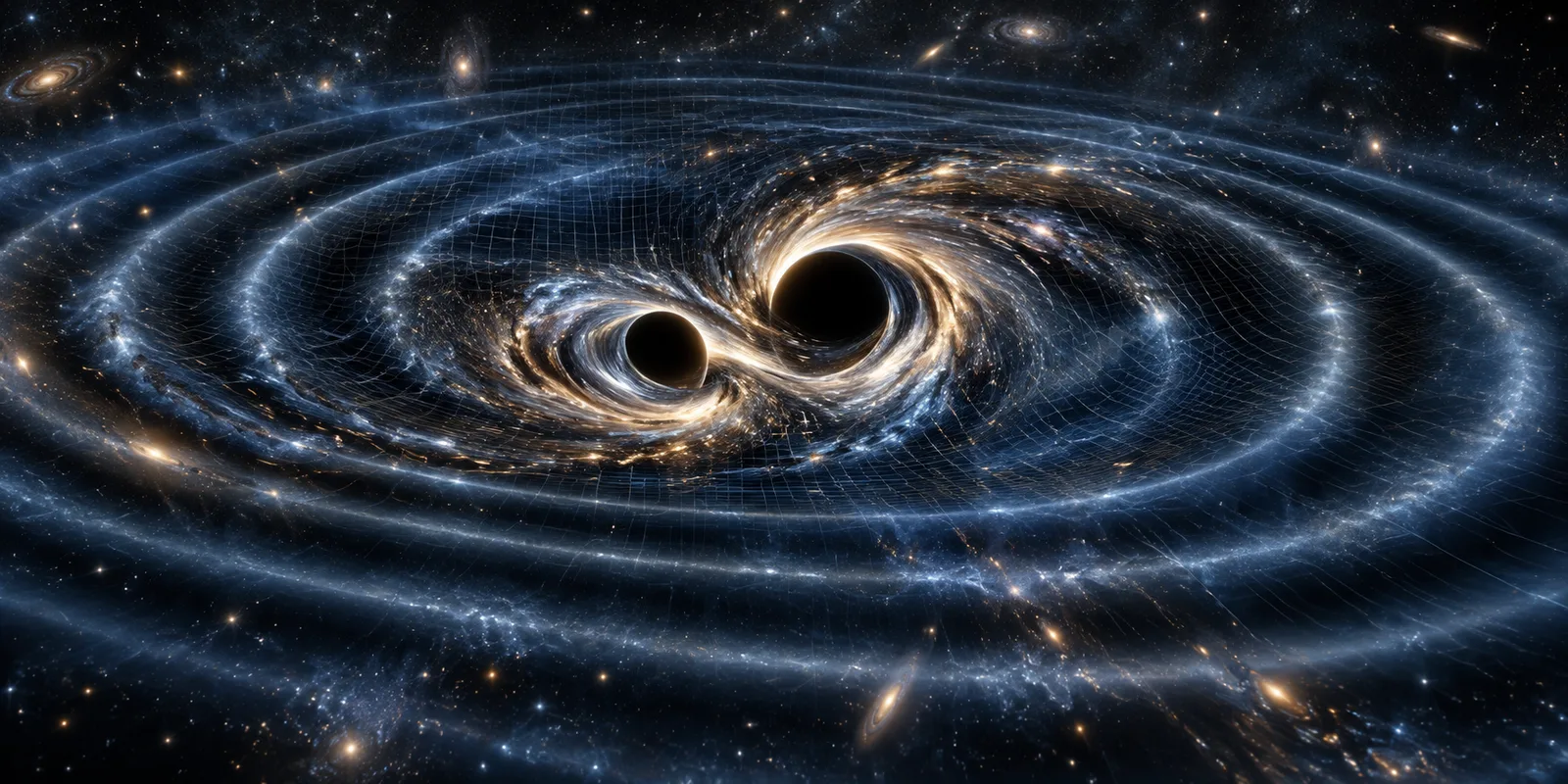
Some rapidly changing mass distributions produce waves that propagate through spacetime. The shape of the signal changes as a black hole binary approaches each other, merges, and the remaining object stabilizes. Thus, a single event provides information from different physical phases. The detector does not take a nice photo of the event; It records very small changes in the measuring device. Model predictions are compared with these records. The colored black hole images in the news are not the observation data itself. The image of this file is only a representative expression.
How is it possible to test the theory?
The basic logic is to compare the prediction of the theory with observation. When the best-fit signal is removed, the compatibility of the remainder with the noise can be examined. The consistency of the parameters obtained from the different phases of the merger can also be questioned. The official summary describes tests such as residual signals, polarisation, propagation and fading vibrations of the last black hole. It is valuable that they differ from each other: the problem that does not appear with one method may become apparent with another. Test methods and results ↗
Separating the noise from new physics
Just because a measurement looks different from the model does not necessarily mean revolution. Calibration, vehicle noise and model approach can also make a difference. Examining these alternatives in science is not to hinder discovery, but to increase the reliability of discovery. When evaluating the result, it is important to ask how many events were examined, as well as the quality of the events and the bias to which the test is sensitive. More measurements do not automatically eliminate every error; common systematic error may remain. Therefore, consistency is sought across independent devices and methods.
Has quantum gravity been solved?
No. The compatibility of general relativity with these observations does not complete the quantum explanation of gravity. While a theory may be very successful at a certain scale and sensitivity, it may need a broader explanation in other circumstances. The headlines “Einstein turned out to be wrong” and “there is nothing to investigate anymore” do not accurately reflect the outcome of this file. The open question is how a possible new explanation would preserve existing successful predictions and yield measurable results that diverge. A mere attractive idea without testable differences does not have the same status as an observational result.
What would be convincing evidence for you?
Is it a single extraordinary piece of news or a systematic deviation repeated by different devices that necessitates abandoning a theory? Your answer to this question makes your understanding of scientific evidence visible. When writing your opinion, try to state the measurement, explanation and future expectation in three separate sentences. For example, “this data was measured”, “this is compatible with the model”, “if this new observation is made, the comparison will be strengthened”. This way, we can talk about today's outcome of the research without confusing it with tomorrow's possibility.